

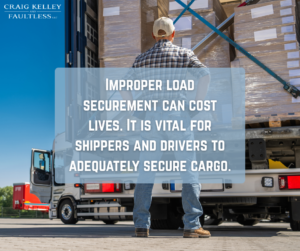
While driving on I-70 in Wayne County, Indiana outside of Richmond on Veteran’s Day 2020, James Alcorn was killed due to a hidden shipping defect that caused large pipes to fall from a semi-tractor trailer.
After the pipes fell from the trailer, the semi driver stopped in the passing lane on the highway. Accident reconstruction found that because of a dip in the road, it would have been extremely difficult for Mr. Alcorn to change lanes or stop before crashing into the back of the parked semi.
Craig, Kelley & Faultless determined that the shipper was liable for the accident because the semi driver would not have stopped on the highway if the pipes had been properly secured. However, cases against the shipper are difficult. In order to hold the shipper responsible, it must be proven that they incorrectly loaded the trailer, the error was hidden, and the truck driver was unaware of the defect. Investigation and preservation of evidence led to the discovery of this latent defect.
But what exactly did the shipper do wrong?
Failure to Follow FMCSA Cargo Rules
The first thing the Craig, Kelley & Faultless legal team did was locate the trailer and missing pieces of pipe. They had an investigator watch the trailer to be sure the remaining pipes were not unloaded without the Craig, Kelley & Faultless team present. The shipping defect revealed itself as the trailer was unloaded. Luckily, the team was able to video tape the unloading of the cargo and prove what the shipper did wrong.
The shipper had used wooden boards on the bottom of the trailer to brace the pipes, but some of these boards were never fastened to the trailer. The load initially seemed secure. However, while the driver was traveling down the highways, those boards moved in response to bumps on I-70. This led to the straps holding the pipes in place to become loose, resulting in them falling from the trailer.
That loading error was considered a hidden defect because once the pipes were loaded, it was impossible to see those boards had not been fastened down.
There are many rules set by the Federal Motor Carrier Safety Administration (FMCSA) that shippers must follow when loading cargo. The general rule is that all “cargo must be firmly immobilized or secure on or within a vehicle by” using structures of appropriate strength, loose materials to support or protect cargo, shoring bars, tiedowns, or a combination of these methods.
For cargo items that are likely to roll, such as pipes, they need to be restrained using chocks, wedges, a cradle or other equivalent method to prevent them from rolling. Most importantly, the means used to prevent rolling must not be capable of unintentional unfastening or loosening while the truck is in transit.
While the shipper that loaded the semi that killed Mr. Alcorn did use the wooden boards as a form of roll prevention, those boards were not secured to avoid loosening while in transit.
Was the Shipper the Only One Held Liable?
The shipper is responsible for the proper loading and securing of cargo onto semi-trailers and flatbeds. When the pipes came loose and fell off the trailer of the semi, forcing the driver to stop in the road, it was the fault of the shipper for failing to secure the pipes according to FMCSA regulations. But they were not the only one liable for the events of the accident.
Each time cargo is loaded and secured to a semi-trailer, the driver is not necessarily required to be present to watch the loading. However, drivers must conduct a pre-trip inspection. They must ensure the truck is in proper working order and that the cargo is properly distributed and secured before driving.
If the cargo is not adequately distributed and secured, it is the driver’s responsibility to adjust the cargo and load securement devices to avoid loosening or loss of cargo. The driver should be familiar with regulations regarding load securement, as well as how to properly secure cargo.
Furthermore, the driver must inspect the cargo and devices used to secure it within the first 50 miles after starting the trip and adjust as necessary. This can include adding more securement devices. They must also continue to examine cargo and load securement devices and adjust if needed throughout the course of transportation.
In Mr. Alcorn’s case, the driver of the semi was not present when the shipper loaded the vehicle. And although the defect in the loading process was considered hidden, it is still the driver’s responsibility to thoroughly inspect the vehicle’s load both before and during the trip. Additionally, the truck driver never should have stopped his semi tractor-trailer in the middle of the interstate. Had he gone a little further down the road, he could have pulled into the median, and this wreck could have been avoided. As a result, the driver of the semi was also held liable for the accident.
The Settlement the Alcorn Family Deserved
The death of Mr. Alcorn left his family struggling with his loss in the wake of his accident. Devastated, Mrs. Alcorn contacted Craig, Kelley & Faultless the day after to get help right away.
Wrongful death of a family member is difficult for everyone involved, leaving the family to handle their grief, as well as medical costs and loss of income. By seeking legal assistance immediately after the wreck, Nationally Recognized Truck Accident Attorney David W. Craig was able to quickly uncover evidence that the shipper could be held liable for the wreck. Because David is Board-Certified in truck accident law by the National Board of Trial Advocacy, he is aware of what to look for in a complicated truck accident case like Mr. Alcorn’s.
The minimum insurance carried by the trucking company was not sufficient compensation for what the family had suffered. But by revealing the driver was not the only one at fault, David had proof of the shipping error, too. Through this revelation, he achieved the settlement that the Alcorn family deserved.
Injured After a Truck Wreck? Craig, Kelley & Faultless Can Help
Attorneys at Craig, Kelley & Faultless are prepared and have the experience to help victims and their loved ones involved in commercial vehicle wrecks through every aspect of their case. Both attorneys David W. Craig and Scott A. Faultless are board-certified in truck accident law by the NBTA, accredited by the American Bar Association. The firm also has a rapid response team that works with investigators, reconstructionists and mechanics who immediately collect evidence as soon as the firm is hired. Additionally, two of the firm’s litigation paralegals are board-certified in truck accident law by the Academy of Truck Accident Attorneys. As David has said, “We don’t just handle truck accident cases. We specialize in these cases.”
Their team-centered approach puts client needs at the forefront, and several attorneys will work on your case to achieve the best possible outcome.
Reach out for a free case consultation today at (888) 253-5198 or online.
David W. Craig is board-certified by the National Board of Trial Advocacy, accredited by the American Bar Association in Truck Accident Law. He sits on the Board of Regents of the Academy of Truck Accident Attorneys (which requires the board certification in truck accident law). He is the managing partner and one of the founding partners of Craig, Kelley & Faultless LLC. He is recognized as a Top 10 Trucking Trial Lawyer and Top 100 Trial Lawyer in Indiana by the National Trial Lawyers, as well as a Top 50 Indiana lawyer by Super Lawyers. David is the author of Semitruck Wreck, A Guide for Victims and Their Families and It’s Never Been Easier to Hire the Wrong Attorney, both written to help people navigate what comes next after a tragic wreck. He also hosts the podcast After the Crash, where you can gain valuable information about the dangers involving semis and large trucks that do not follow safety protocol regarding speed, weather conditions, maintenance upkeep, etc.

 Email
Email Facebook
 Twitter
 Linkedin
 Instagram