

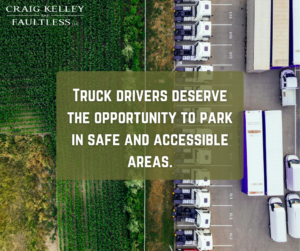
Truck drivers travel all across the country to deliver goods on time. In order to meet the demands of their schedules and ensure they drive safely, truckers need places to safely park and rest. However, the current national truck parking shortage can have dangerous consequences that affect everyone on the roads, not just truck drivers.
The U.S. Department of Transportation found that 98% of truck drivers regularly experience difficulties while trying to find safe parking in 2023, which is a stark increase from the 75% reported four years prior. This is an issue that persists in every state and region in the country. And with an expected 21% increase in the volume of freight being moved over the next decade, this is an issue that desperately needs to be addressed.
Problems Truck Drivers Face Due to the Parking Crisis
As the amount of supply in the carrier market has increased, it has become more apparent that there is a lack of investment in rest areas and truck stops to match the pace of expansion. With one spot available for every 11 trucks, drivers are faced with the daily hardship of trying to find safe and legal parking.
Semis and other large trucks require special parking because of their size. Drivers also need spaces that provide easy access, advanced security, and are in the vicinity of essential amenities like bathrooms. But when these spots are full, drivers are faced with the decision of either parking in unsafe and illegal areas or violating their hours-of-service regulations to continue searching for safe parking.
When truck drivers are unable to find legal parking, they often park in unsafe areas, such as highway shoulders and interstate entrance and exit ramps, which create safety risks for themselves and other drivers. In fact, 84% of truck drivers do not feel safe when they park in unauthorized areas. Parking on highways and interstate ramps can create a variety of safety risks, including an increased risk of accidents. These stretches of road were created with the intention of high speeds, acceleration, and deceleration, not for parking vehicles. Parking in these areas creates unexpected obstacles for drivers, which can ultimately reduce visibility and affect drivers’ reaction time. This creates more risk of collisions, especially late at night when truck drivers are more likely to park and rest.
There is also more risk of trucks sustaining damage while parked in unauthorized areas. Unfortunately, everyone drives with varying degrees of caution, and parking on highways and interstate ramps exposes trucks to side swipes and fender benders. Overall, such incidents can lead to increased maintenance costs for drivers and their employers.
Additionally, each state has different laws regarding unauthorized parking, and truck drivers can face tickets and fines, depending on how strict local law enforcement is about parking. This also puts law enforcement in the difficult position of either allowing drivers to remain illegally parked or force drivers to move their vehicle and park elsewhere, which may place them in violation of the hours-of-service rules and risk that truckers may be too fatigued to safely relocate.
Potential Solutions to the Parking Shortage
There are many efforts being made to try to alleviate the truck parking crisis. There have been several attempts to pass federal legislation to create more parking, such as the Truck Parking Safety Improvement Act, but state governments are coming up with solutions, as well. In Indiana, private firms and the Indiana Department of Transportation (INDOT) have been working to expand capacity. INDOT is currently embarking on a plan to add 1,200 spaces to the currently allocated 1,400 spaces. There are also plans to close certain rest areas along I-65 in Indiana to convert them into truck parking-only facilities.
Truck Parking Club is another temporary solution to the shortage. The company works with local private property owners to monetize their vacant or underutilized land and create available parking for truckers. And while there are drivers critical of paid parking, with many believing that truck parking should be free to avoid drivers taking on the cost of parking, Truck Parking Club can help drivers who may have no other options.
Injured After a Truck Wreck? Craig, Kelley & Faultless Can Help
Attorneys at Craig, Kelley & Faultless are prepared and have the experience to help victims and their loved ones involved in commercial vehicle wrecks through every aspect of their case. Both attorneys David W. Craig and Scott A. Faultless are board-certified in truck accident law by the NBTA, accredited by the American Bar Association. The firm also has a rapid response team that works with investigators, reconstructionists and mechanics who immediately collect evidence as soon as the firm is hired. Additionally, two of the firm’s litigation paralegals are board-certified in truck accident law by the Academy of Truck Accident Attorneys. As David has said, “We don’t just handle truck accident cases. We specialize in these cases.”
Their team-centered approach puts client needs at the forefront, and several attorneys will work on your case to achieve the best possible outcome.
Reach out for a free case consultation today at (888) 253-5198 or online.
David W. Craig is board-certified by the National Board of Trial Advocacy, accredited by the American Bar Association in Truck Accident Law. He sits on the Board of Regents of the Academy of Truck Accident Attorneys (which requires the board certification in truck accident law). He is the managing partner and one of the founding partners of Craig, Kelley & Faultless LLC. He is recognized as a Top 10 Trucking Trial Lawyer and Top 100 Trial Lawyer in Indiana by the National Trial Lawyers, as well as a Top 50 Indiana lawyer by Super Lawyers. David is the author of Semitruck Wreck, A Guide for Victims and Their Families and It’s Never Been Easier to Hire the Wrong Attorney, both written to help people navigate what comes next after a tragic wreck. He also hosts the podcast After the Crash, where you can gain valuable information about the dangers involving semis and large trucks that do not follow safety protocol regarding speed, weather conditions, maintenance upkeep, etc.

 Email
Email Facebook
 Twitter
 Linkedin
 Instagram