

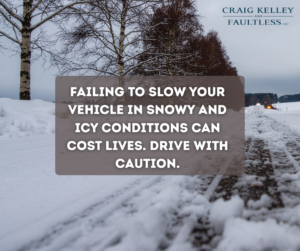
Every winter season, crashes occur due to drivers failing to change their driving habits to accommodate snowy and icy conditions. Over 70% of roads in the United States are located in regions that receive more than five inches of average snowfall annually, with nearly 70% of the nation’s population living in these regions. A majority of Americans face the challenges of driving in wintery conditions, as well as the risk of being in a serious accident.
In 2023, there were 320 fatal traffic accidents and 22,293 injury crashes where snow/sleet conditions were present at the time of the crash. These wrecks can be attributed to many factors, such as lack of vehicle preparation for winter conditions, visibility issues, or failing to pay close attention to road conditions. But the biggest factor is speed.
How Does Speed Affect My Driving in Winter Conditions?
While you may feel comfortable speeding on dry pavement, the introduction of snow and ice on roadways drastically changes how your vehicle drives and handles speed. Pavement friction and vehicle maneuverability are reduced in these conditions, leading to slower speeds and reduced roadway capacity. When driving on arterial roads, speeds can decline by 30% to 40% if pavement is snowy or slushy. For freeways, light snow can reduce speeds by 3% to 13% in light snow and 5% to 40% in heavy snow.
These conditions drastically change your vehicle’s ability to grip the pavement, reducing the traction between your tires and the roads surface. Driving at your normal speed, or speeding in general, can cause your vehicle to suddenly skid because of reduced traction, which could lead to loss of control. Additionally, as the vehicles around you reduce their speeds to accommodate the roads’ new terrain, failing to slow your vehicle can result in dangerous accidents. This is especially important for those operating semi-trucks or other heavy trucks because their weight and size make it difficult to stop once control is lost, often leading to devastating accidents and pile ups.
Furthermore, slowing your vehicle takes longer in snowy and icy conditions due to lack of traction. This means the braking distance required to come to a stop quickly doubles, and the faster you go, the longer it takes to stop. To compensate, you should drive slower, increase following distance, and begin braking earlier than you would in normal conditions. Truck drivers should follow the rules laid out in the Federal Motor Carrier Safety Regulations and Commercial Driver’s License (CDL) Manual, which state that drivers should exercise extreme caution and reduce speed by at least 50%. Failure to increase following distance means you may not be able to brake in time to prevent an accident, and slamming the brakes can cause your vehicle to fishtail, spin, or jackknife if you are driving a semi tractor-trailer.
As you reduce your speed, it is important to remember not to crowd snowplows or travel beside them. Plows drive at very slow speeds, make wide turns, stop frequently, overlap lanes, and often exit the road. When driving behind or near snowplows, stay far behind it and use caution if you must pass it. Our law firm has handled several cases where the accident was caused in whole or in part by snowplows.
Visibility can also decrease if you are driving during heavy snowfall, which then alters how much stopping distance you have. According to section 2.6 of the CDL Manual, the total distance needed to stop your vehicle is a combination of perception distance, reaction distance, and braking distance. Perception distance is greatly affected by visibility; it is the distance your vehicle travels from the time your eyes see a hazard and then the brain recognizes it. The average perception time for an alert drive is 1 ¾ seconds in ideal conditions. Reaction distance is the distance you will continue to travel before actually hitting the brakes, which is about ¾ of a second to one second in normal conditions. For braking distance, a semi-truck needs 216 feet to stop on dry pavement while driving at 55 mph.
When heavy snowfall drastically reduces visibility, those seconds become milliseconds. Speeding or driving faster than the weather safely allows makes it more difficult to stop or reduce your speed safely when you encounter another vehicle or obstacle that was not visible earlier. And once you see the obstacle, you may not have enough distance to hit your brakes while driving on slick and snowy roads.
Overall, it is crucial for all drivers to reduce their speeds while driving on snow and ice, regardless of the size of their vehicles. Even if you believe you have complete control of your vehicle, it only takes one patch of snow or ice to make you skid or spin out of control. Exercising caution and remaining vigilant while driving in winter weather can save your life and the lives of those around you.
Injured After a Winter Weather Accident? Craig, Kelley & Faultless Can Help
Attorneys at Craig, Kelley & Faultless are prepared and have the experience to help victims and their loved ones involved in commercial vehicle wrecks through every aspect of their case. Both attorneys David W. Craig and Scott A. Faultless are board-certified in truck accident law by the NBTA, accredited by the American Bar Association. The firm also has a rapid response team that works with investigators, reconstructionists and mechanics who immediately collect evidence as soon as the firm is hired. Additionally, two of the firm’s litigation paralegals are board-certified in truck accident law by the Academy of Truck Accident Attorneys. As David has said, “We don’t just handle truck accident cases. We specialize in these cases.”
Their team-centered approach puts client needs at the forefront, and several attorneys will work on your case to achieve the best possible outcome.
Reach out for a free case consultation today at (888) 253-5198 or online.
David W. Craig is board-certified by the National Board of Trial Advocacy, accredited by the American Bar Association in Truck Accident Law. He sits on the Board of Regents of the Academy of Truck Accident Attorneys (which requires the board certification in truck accident law). He is the managing partner and one of the founding partners of Craig, Kelley & Faultless LLC. He is recognized as a Top 10 Trucking Trial Lawyer and Top 100 Trial Lawyer in Indiana by the National Trial Lawyers, as well as a Top 50 Indiana lawyer by Super Lawyers. David is the author of Semitruck Wreck, A Guide for Victims and Their Families and It’s Never Been Easier to Hire the Wrong Attorney, both written to help people navigate what comes next after a tragic wreck. He also hosts the podcast After the Crash, where you can gain valuable information about the dangers involving semis and large trucks that do not follow safety protocol regarding speed, weather conditions, maintenance upkeep, etc.

 Email
Email Facebook
 Twitter
 Linkedin
 Instagram