

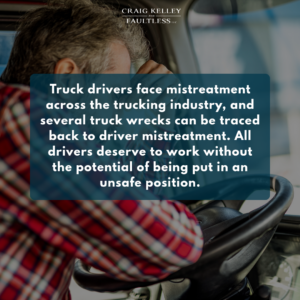
Once a semi-truck driver is found to be at fault for a truck wreck, some people believe that is the end of the case. But not all truck crashes are that simple. Although the driver is liable for the crash, there may other factors or parties involved that contributed to that wreck, such as potential driver mistreatment and exploitation from trucking companies.
While there are truck drivers who are sole bad actors, majority of drivers are good, professional people simply trying to make a living to support themselves and their families. Most drivers never intend to cause harm, but mistreatment from superiors can create conditions where the driver is coerced into operating their vehicle when it is not safe to do so. This mistreatment and exploitation is all too common in the trucking industry and can lead to serious truck wrecks.
How Does Driver Mistreatment Lead to Truck Wrecks?
The Federal Motor Carrier Safety Regulations (FMCSRs) and Commercial Driver’s License (CDL) manual contain clear outlines of the rules and regulations drivers must follow to ensure they are safely operating their vehicles. Many of these rules cover things like hours-of-service regulations to prevent fatigued driving, usage regulations for electronic or paper logs for tracking hours-of-service, guidelines for pre- and post-trip inspections of vehicles to ensure everything is in safe working order, rules for using communication devices while driving, and even standards for how truck drivers should respond to adverse weather conditions.
These regulations are standard in the trucking industry, and most trucking companies ensure they and their drivers respect them. However, there are companies that choose to prioritize profit instead of safety, which can result in supervisors forcing drivers to violate these regulations to meet company expectations.
Truck drivers may feel obligated to comply with the wishes of their superiors, even if they are unethical, simply to protect their livelihoods. If they choose to go against their superiors, they potentially face retaliation in the form of reduced hours or termination. In these situations, some drivers may choose to comply to prevent a loss of hard-earned wages.
This exploitation can come in many forms, like forcing drivers to alter their hours-of-service logs to drive beyond the number of hours they are legally allowed to work, operate their vehicles even when something is in need of repair because it could delay the company’s delivery schedules, continue driving through adverse weather conditions, answer texts or calls from dispatch while driving, and more. All of these examples can result in serious truck crashes due to the increased danger they create.
An Industry-Wide Problem
Mistreatment of drivers doesn’t stop with the trucking companies. When driving their routes, truck operators often work with shippers and receivers who manage the cargo loads. Shippers help to safely load cargo onto the correct trucks and receivers unload the cargo at the end destination. But there are some shippers and receivers who subject truck drivers to poor treatment, making them wait long hours on loading docks to have their cargo unloaded without access to bathrooms.
These long wait times can result in lost wages and fatigued driving because drivers are in “detention time” without pay while they wait for loading/unloading, and the limit for their hours-of-service does not stop while they are in detention time. So, if their limit expires while they are waiting, but the trucking company wants them to complete the delivery route anyway, they are forced to operate their trucks while fatigued. This creates a vicious cycle where the truck driver is consistently made to disregard critical safety regulations.
Until there is more effort made to enforce regulations and the fair treatment of truck drivers, wrecks caused by these factors will continue to happen. All truck drivers deserve to be treated fairly in the workplace and have the freedom to report unsafe behavior without fear of retaliation. Otherwise, it’s only a matter of time before a truck driver is put in a position that creates risks for everyone on the roads.
Ask David: Episode 94 of After the Crash with Ashley Napier
David W. Craig is the managing partner and a founding member of Craig, Kelley & Faultless, a personal injury and wrongful death law firm. He has authored two books, Semitruck Wreck: A Guide for Victims and Their Families and It’s Never Been Easier to Hire the Wrong Attorney, to help victims navigate the legal process.
Ashley Napier is the Litigation Supervisor at Craig, Kelley & Faultless. She is a crucial member of the firm’s legal team, working to keep attorneys, file managers, legal assistants, and law clerks on track.
She and David discussed continued legal education and driver mistreatment on a recent episode of After the Crash, David’s free podcast. Nationally ranked among personal injury podcasts on FeedSpot, After the Crash educates and empowers listeners.
Ashley asked David questions about his presentation on driver mistreatment to a national audience of truck accident lawyers in Denver, Colorado at the Academy of Truck Accident Attorneys (ATAA) Symposium during episode 94.
Injured in a Truck Wreck? Craig, Kelley & Faultless Can Help
Attorneys at Craig, Kelley & Faultless are prepared and have the experience to help victims and their loved ones involved in commercial vehicle wrecks through every aspect of their case. Both David W. Craig, Scott A. Faultless are board-certified in truck accident law by the NBTA, accredited by the American Bar Association. The firm also has a rapid response team—including investigators, reconstructionists and mechanics—that is sent to the scene of a wreck to collect evidence as soon as the firm is hired.
Their team-centered approach puts client needs at the forefront, and several attorneys will work on your case to achieve the best possible outcome.
Reach out for a free case consultation today at (317) 434-3520 or online.
David W. Craig is board-certified in truck accident law by the National Board of Trial Advocacy, accredited by the American Bar Association in Truck Accident Law. He sits on the Board of Regents of the Academy of Truck Accident Attorneys. He is the managing partner and one of the founding partners of Craig, Kelley & Faultless LLC. He is recognized as a Top 10 Trucking Trial Lawyer and Top 100 Trial Lawyer in Indiana by the National Trial Lawyers, as well as a Top 50 Indiana lawyer by Super Lawyers. David is the author of Semitruck Wreck: A Guide for Victims and Their Families and It’s Never Been Easier to Hire the Wrong Attorney, both written to help people navigate what comes next after a tragic wreck. He also hosts the podcast After the Crash, where you can gain valuable information about the dangers involving semis and large trucks that do not follow safety protocol regarding speed, weather conditions, maintenance upkeep, etc.

 Email
 Facebook
 Twitter
 Linkedin
 Instagram