

Truck drivers spend long hours behind the wheel every day. From morning to night, it is important for them to remain focused and vigilant while transporting goods over long distances. But the mental and physical demands of this job require drivers to be in good health so they can do their jobs safely.
Those who choose to drive professionally are subjected to thorough physicals that assess for any medical conditions that could affect their ability to safely drive. Each driver must meet the strict medical qualifications created by the Department of Transportation (DOT) in order to receive their Medical Examiner’s Certificate, or DOT Medical Card, and must be assessed by an approved medical examiner.
Who Can Perform DOT Medical Exams?
When a professional driver needs to undergo a medical examination before they are cleared to drive, they must go to a physician that has been approved by the DOT. There are several different types of physicians that drivers may have conduct their examination, but the physician must be certified by the Federal Motor Carrier Safey Administration (FMCSA) to do so. Those that are FMCSA certified are listed on the National Registry of Medical Examiners.
Physicians must meet the following requirements to become certified:
- Be licensed, registered, or certified to perform physical exams according to applicable state laws and regulations.
- Register on the National Registry website and receive a National Register number.
- Complete training that covers the Federal Motor Carrier Safety Regulations (FMCSRs) and any related guidance.
- Pass the National Registry Medical Examiner Certification Test.
The types of physicians that are allowed to perform DOT medical exams include doctors of medicine, doctors of osteopathy, doctors of chiropractic, physician assistants, and advanced practice nurses.
What Are the Physical/Medical Qualifications to Drive a Semi-Truck?
The medical examination truck drivers must go through is a full physical work-up, which tests for and includes:
- A neurological exam to check reflexes and coordination. Seizure disorders, such as epilepsy, can disqualify a driver.
- A hearing test. Operators must be able to hear a forced whisper from a five-foot distance.
- A vision exam. Drivers are required to have at least 20/40 vision in each eye.
- A lung function assessment. This can identify respiratory dysfunctions, such as chronic asthma or obstructive sleep apnea.
- A urine test. This may identify diabetes or kidney disease.
- A blood pressure test. Drivers must have blood pressure that is at or below 140/90 with or without medication.
Each of these assessments are meant to catch any health concerns that could impair safe driving ability, lead to a medical emergency, or contribute to inattention while driving. There are exemptions to the regulations or disqualifiers, such as medications or aids to manage certain conditions, but drivers are required to adhere to the treatments needed to qualify for exemptions.
Whose Responsibility Is It to Ensure Only Medically Qualified Drivers Are Behind the Wheel?
There are multiple people who play a role in ensuring medically unfit drivers do not receive medical certification.
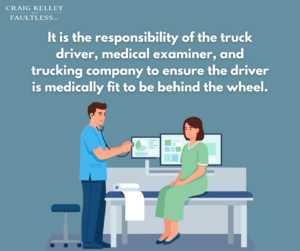
On the most recent episode of After the Crash, Dr. David Fletcher spoke with Nationally Recognized Truck Accident Attorney David W. Craig about the medical fitness of truck drivers. He described this responsibility as a “three-legged stool” that upholds accountability, which consists of the driver, the medical examiner, and the trucking company.
The first leg is the truck driver. When a driver goes in for their medical examination, it is crucial that they are completely honest with their physician about the state of their health. Some drivers may feel they need to lie to the examiner to protect their livelihood because some conditions could disqualify them from driving. However, there are many conditions that are not a permanent bar from trucking, but they need to treat the problem so they are in compliance with medical requirements. Ultimately, a driver’s honesty is what keeps people on the roads safe.
The second leg is the medical examiner. As the physician is conducting their exam, it is vital for them to cover every aspect of the driver’s health. This requires them to ask probing questions, pay attention to driver history, investigate medications being taken that could impair the driver, and follow-up on any abnormalities that need additional testing. If the medical examiner is not thorough during the physical, it could lead to a driver receiving medical certification when they are not qualified for it.
The third leg is the trucking company or motor carrier. After the driver goes through their physical and the truck company is sent their long form, or results of the medical exam, it is their responsibility to audit and meticulously go through the results. This allows them to ensure the physician did not miss anything during the examination.
When a truck accident happens because the driver was not medically fit to operate their vehicle, the liability for the wreck could lie with the driver, the examiner, and/or the trucking company. If all three are honest and thorough during the medical examination process, it can prevent accidents and save lives.
Get to Know the Guest: A Doctor with a Duty to the Public
Dr. David Fletcher is a licensed physician from Illinois who is double certified in occupational and preventive medicine. He is also the Medical Director and CEO of SafeWorks in Illinois, as well as a certified medical review officer.
Earlier in his career, Dr. Fletcher worked as a certified Aviation Medical Examiner for pilots as part of the Federal Aviation Administration (FAA). Later on, he questioned why the FMCSA did not have a similar medical examination system to the FAA, which led to him taking up a leadership role with the American College of Occupational and Environmental Medicine. There, he worked on training for doctors to become familiar with proper evaluations for professional drivers—one of the first programs of its kind.
Now, he is considered an important advocate for proper medical examinations and has often worked as an expert witness for both plaintiffs and defendants in truck wreck cases for over 35 years.
After the Crash Podcast: A Legal Resource for Truck Wreck Victims
After the Crash is currently ranked No. 5 in personal injury podcasts. It is the highest-ranked podcast focusing on personal injury resulting from commercial vehicle and truck wrecks.
The podcast was launched over five years ago, in the fall of 2020, by attorney David W. Craig. It educates and empowers listeners in a digestible format. It is primarily aimed at the victims and the families of victims of semi or other large truck accidents.
It is David’s goal to equip listeners with the knowledge necessary to navigate this tough time in their lives. Anyone — truck wreck survivors, legal professionals, healthcare workers, and anyone in between — can tune into After the Crash for free.
A new episode is released monthly, featuring a guest with an important perspective. In each episode, David interviews individuals involved in commercial motor vehicle cases, or experts whose skills are crucial to understanding trucking cases.
Episodes are posted on YouTube, Spotify, Amazon and Apple Podcasts, and the Craig, Kelley & Faultless website.
Injured After a Truck Wreck? Craig, Kelley & Faultless Can Help
Attorneys at Craig, Kelley & Faultless are prepared and have the experience to help victims and their loved ones involved in commercial vehicle wrecks through every aspect of their case. Both attorneys David W. Craig and Scott A. Faultless are board-certified in truck accident law by the NBTA, accredited by the American Bar Association. The firm also has a rapid response team that works with investigators, reconstructionists and mechanics who immediately collect evidence as soon as the firm is hired. Additionally, two of the firm’s litigation paralegals are board-certified in truck accident law by the Academy of Truck Accident Attorneys. As David has said, “We don’t just handle truck accident cases. We specialize in these cases.”
Their team-centered approach puts client needs at the forefront, and several attorneys will work on your case to achieve the best possible outcome.
Reach out for a free case consultation today at (888) 253-5198 or online.
David W. Craig is board-certified by the National Board of Trial Advocacy, accredited by the American Bar Association in Truck Accident Law. He sits on the Board of Regents of the Academy of Truck Accident Attorneys (which requires the board certification in truck accident law). He is the managing partner and one of the founding partners of Craig, Kelley & Faultless LLC. He is recognized as a Top 10 Trucking Trial Lawyer and Top 100 Trial Lawyer in Indiana by the National Trial Lawyers, as well as a Top 50 Indiana lawyer by Super Lawyers. David is the author of Semitruck Wreck, A Guide for Victims and Their Families and It’s Never Been Easier to Hire the Wrong Attorney, both written to help people navigate what comes next after a tragic wreck. He also hosts the podcast After the Crash, where you can gain valuable information about the dangers involving semis and large trucks that do not follow safety protocol regarding speed, weather conditions, maintenance upkeep, etc.
 Email
Email Facebook
 Twitter
 Linkedin
 Instagram